

Listen to me – June 2024
The music streaming ecosystem is a network of mind-boggling complexity that sits between the artists who create music and the people who listen to it. In between, huge sums of money are made.
In this blog I provide a helicopter view of the ecosystem that shows its basic logic. In later blogs I will zoom in on parts of the system, analyze their mechanics, and suggest possible improvements.
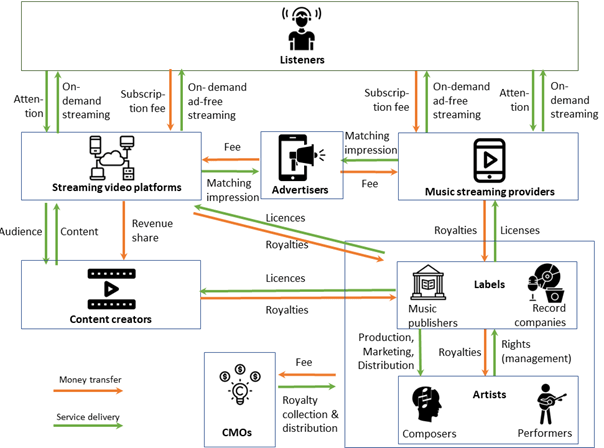
The following diagram shows the core part of the music streaming ecosystem.
This is the core part, as there are many more entities that play a role: independent producers, contract lawyers, regulators, IP lawyers, distributors, competition lawyers, agents, regulators, managers, audio recognition companies, and more lawyers.
What do we see in the above picture?
Each box represents a set of economic entities.Arrows represent a transfer of value from one entity to another. Red arrows are money transfers, green arrows are transfers of some valuable product or service.
At the top, we have the listeners listen to streamed music on-demand. This is the value proposition of the entire network.
Listeners may stream music from on-demand streaming providerssuch as Spotify, Apple Music, Amazon Music, YouTube Music, Deezer, Tidal, SoundCloud, and others.
For simplicity, I omitted background music streaming in bars, restaurants, supermarkets, and other venues. Consumers hear this music but do not listen to it on-demand. I also omit online radio, where the radio station and not the listener chooses the music to be streamed.
Streaming video platforms like the YouTube Platform and TikTok host video content creators who make their videos available on the platform. The difference with music streaming providers is that a platform hosts user-generated content, where a streaming provider streams music for which it obtained a license from the IP holder in advance.
Streaming providers and platforms are funded by advertisers. They also have an ad-free premium version funded by subscription fees.
Video publishers and streaming providers must obtain licenses from the intellectual property holders of the music, the artists, publishers, and record companies, to stream music to consumers.
Different groups of artists (composers, performers) have different rights, such as author rights, reproduction rights, and neighboring rights. Composers mandate music publishers to manage their rights in return for a percentage of their royalty. Performers transfer their rights to record companies in return for a percentage of the royalties. The details are complex and do not concern us here [1] [2].
Collective Management Organizations (CMOs) perform the complex task of collecting royalties for the use of licensed music on behalf of authors and performers.
The logic of the diagram is straightforward: Artists create music, which is financed, distributed, and sold by labels. Listeners stream music through music streaming providers and streaming platforms. This is funded by advertisements and subscription fees. CMOs perform the complex task of collecting royalties for the license to use, distribute, and play music.
What could possibly go wrong?
It turns out that artists’ revenue from streaming is lopsided. Many artists complain that they cannot make a living from streaming. But the alternative payment models proposed so far do not solve this problem.
Part of the problem is that the music streaming providers themselves have been loss-giving. This in turn is related to the royalty payments the streaming providers must make to the major record companies, eating up a large part of the providers’ revenue. The major record companies in turn are under threat of the big music platforms YouTube and TikTok, who try to reduce royalty payments as much as possible. Record companies and collective management organizations collect royalties on behalf of creators using a system of intellectual property rules that is maddeningly complex.
In future blogs I will zoom in on these problems, explain their structure, and suggest possible solutions.
Read the complete white paper about the music streaming ecosystem here. Our book Digital Business Ecosystems: How to Create, Deliver and Capture Value in Business Networks, TVE 2023, gives more information about how to design and analyze business models for business ecosystems. Available at www.thevalueengineers.nl.
References
| [1] | S. Gordon, The Future of the Music Business. Fourth Edition, Hal Leonard Books, 2015. |
| [2] | D. S. Passman, All You Need to Know About the Music Business. Eleventh Edition, Simon & Schuster, 2023. |
 Music360